★★★★★
Finally, an AI business guide that doesn't make everything sound complicated. The step-by-step approach helped me understand where to start and what to focus on first.
Alex M
Aspiring Entrepreneur
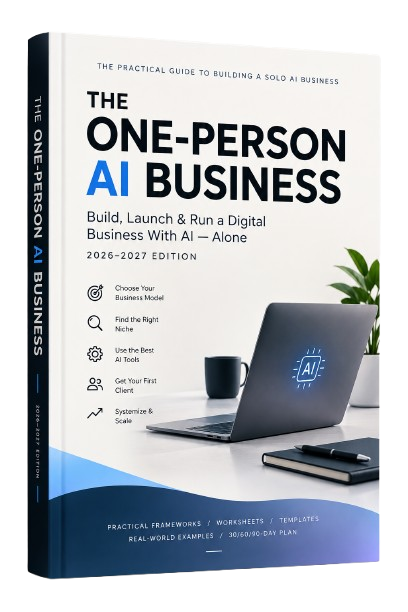
A practical field manual for choosing your business model, finding a niche you can actually reach, pricing your offer, landing your first client without an audience, and systemizing delivery as you grow.
Instant digital access · Read at your own pace · Practical frameworks, worksheets & templates
If you have spent months collecting tools and tutorials without shipping an offer, the problem was never effort. It was the absence of a sequence.
For most of business history, serving many customers required many people: someone to sell, someone to deliver, someone to support, someone to keep the books. One focused person can now research, write, design, build software and run client operations that used to need a small team.
The book's premise is the gap between what these tools can already do and how few businesses have actually put them to work. The opportunity is not AI itself. It is knowing how to apply it to a problem someone will pay to solve.
Not another overview of what AI can theoretically do. It is written as a field manual — 25 chapters, seven appendices, and worksheets you fill in as you go — organised in the order you will actually move through as a solo founder.
It takes you from choosing a model and a niche, through assembling a toolkit, building and pricing an offer, getting the first client, delivering, systemizing and retaining — to climbing the scaling ladder without hiring a team you never wanted.
The mindset shift from doing every task to orchestrating systems, plus a deep dive into the four major solo AI business models and a worksheet for choosing between them.
Pick a niche ranked by access rather than theory, assemble the smallest toolkit that works, and cover the legal, contract and getting-paid basics in plain English.
Turn a capability into a one-sentence offer, price the outcome instead of your hours, land a first client without an audience, and run the discovery call.
Write SOPs from the first client onward, communicate and retain, monitor systems that quietly drift, and build money habits that survive tax season.
Climb the scaling ladder without hiring, sidestep the pitfalls that stall most solo founders, and execute a 30/60/90-day plan instead of reading a twenty-sixth chapter.
You do not have to guess which one fits. Each model gets a full chapter on how it works, where it breaks down, and a composite example — then a worksheet and a decision rule settle it.
Start with a service if you are starting from zero. A product needs an audience before it earns a dollar; a service needs only one client.
Getting a first client is not a creativity problem. It is two variables: putting a specific offer in front of enough of the right people, and giving them a reason to believe you will not waste their money.
Not a category. "I do AI automation" is a category; a missed-call text-back system live within a week is a service.
Something you can show before anyone has paid you. Proof of working beats a description of working.
Each message carries one specific, personalised observation about that business — the book includes the four-part framework and a worked example.
A short pilot rather than a large retainer. A cheap way to say yes, and a paid opportunity to prove the result.
One happy client and one honest testimonial in your first month is a strong outcome — and the foundation everything after it is built on.
Notice what is missing from the book's outreach example: the word "AI." You open with the problem the owner already feels, not with the technology behind your fix.
Four pricing models, a worked example that anchors your price to the client's own numbers, a negotiation script for budget pushback, and the starting ranges discussed in the book:
These are illustrative ranges discussed in the book, drawn from market reporting — not guaranteed pricing, guaranteed income, or a promise about what you will earn. Confirm current rates in your own market.
"Price the outcome, not the hours. A workflow that saves a client ten hours a week is worth far more than the single hour it took you to build."
The book's approach: start with the smallest possible toolkit, and add a specialized tool only when a real bottleneck justifies the cost. Free tiers cover a first pilot; a working budget of roughly $40–$80 a month is typical once a client is paying.
Tool names are referenced for orientation only. All trademarks belong to their respective owners; no endorsement, affiliation or sponsorship is implied.
One narrow decision after another, in roughly this order — with the chapter behind each step.
All of this is part of the book itself — not separate add-ons.
These are composites built from patterns reported across many solo founders — illustrative teaching examples, not testimonials and not descriptions of any single real business. They show how the frameworks play out end to end, including one that went wrong and recovered.
No claim is made that any reader will replicate these outcomes.
Consulting & automation for dental and med-spa practices, starting from a single low-risk 30-day pilot.
A freelance writer turning inconsistent one-off work into a fixed monthly package for local home-service businesses.
A narrow subscription tool for small clinics, launched to an audience that already existed before the product did.
Three unrelated niches at once, then the fix: depth in one lane had been compounding the whole time.
After the twelfth near-identical engagement, custom scoping became a fixed-price, fixed-scope package.
A small product covering baseline recurring revenue, with higher-priced consulting layered on top of it.
What all six share: one narrow niche, one specific first offer, and growth that came from depth rather than breadth.
Finally, an AI business guide that doesn't make everything sound complicated. The step-by-step approach helped me understand where to start and what to focus on first.
The section on business models was incredibly useful. It helped me stop jumping between random ideas and start thinking about AI from a business perspective.
I always assumed building a business required a team, a big budget and a complicated setup. This book showed me how much can actually be done as a solo operator with the right AI systems.
The book is direct about this: every model in it still requires real, focused work — outreach that gets ignored, projects delivered properly, and worksheets actually filled in.
This edition was compiled from reporting on solo, AI-assisted businesses through the middle of 2026 — founder accounts, industry pricing guides, no-code platform comparisons, and market analyses of the micro-SaaS and AI-agency space. Where a specific number appears, it reflects a pattern seen across multiple independent sources rather than a single anecdote.
Two kinds of examples appear throughout, and the book keeps them separate: real, sourced patterns, and clearly labelled composite case studies that illustrate how those patterns play out for one illustrative person.
Markets move quickly here. Treat every dollar figure and tool name as directionally accurate rather than exact. There are no testimonials, reader counts or income claims on this page, because none have been provided — only a description of what the book contains.
Instant digital access
Pick a model. Pick a niche. Build one useful offer. Start.
Instant digital access · Read at your own pace